Pavement ants and moisture-seeking carpenter ants exploit distinct structural pathways across Yellowstone County. Pavement ants push structural sub-soil up through expansion joints, concrete basement slabs, and garage…
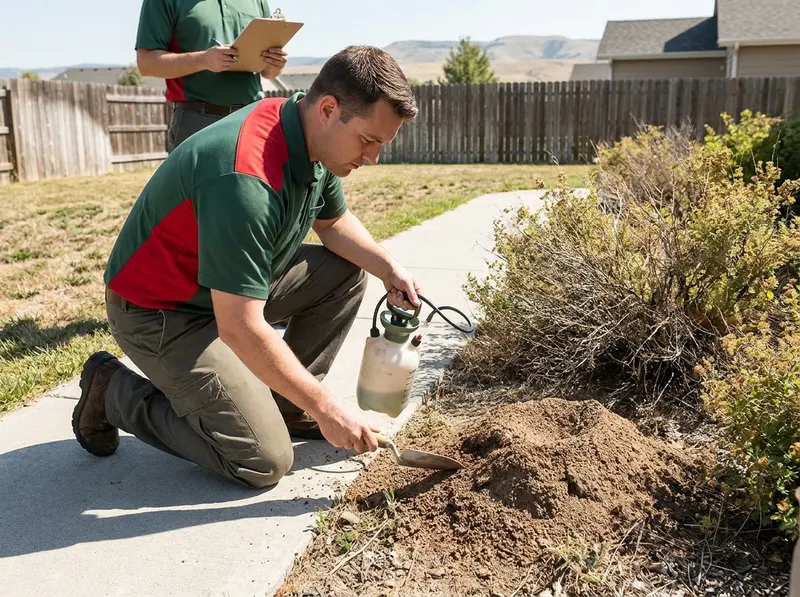
Pavement ants and moisture-seeking carpenter ants exploit distinct structural pathways across Yellowstone County. Pavement ants push structural sub-soil up through expansion joints, concrete basement slabs, and garage footings in Central - Terry and South Side properties. In contrast, carpenter ants do not consume wood; they excavate galleries within moist sill plates, wall studs, and window rough-ins where insulation condensation builds up during Montana winter freeze transitions. In neighborhoods near the Yellowstone River and elevated areas like Billings Heights or North Elevation, seasonal temperature swings force satellite colonies indoors in search of honeydew residues and kitchen pantry proteins.
Surface contact sprays kill foraging worker ants within 15 minutes, but they fail to resolve deep colony pressures. Repellent formulations trigger colony budding, causing a single queen to distribute secondary colonies deeper into interior drywall voids. Professional colony management relies on slow-acting, non-repellent liquid micro-emulsions and specialized granular bait matrices. Foragers carry the active material back into the primary sub-slab or landscape nest over a 48 to 72 hour period, sharing the lethal dose across multiple reproductive queens and the larval brood through trophallaxis.
Exterior treatments account for local architectural designs, from patio homes in Fox Run and Ironwood to acreage foundations in Lockwood and Lake Hills. Ground-level barriers are applied directly to sandstone masonry lines, deck ledges, and weep holes up to 2 feet above the foundation wall and 3 feet out into adjacent soil. This boundary blocks outdoor parent nests from sending foraging columns across warm concrete stems. Property owners face a direct operational trade-off: a topical single-visit bait deployment addresses active indoor trailing within 7 to 10 days, whereas a complete barrier application coupled with wall-void dusting eliminates structural satellite nests while preventing seasonal outdoor re-infestation.
Every job gets a firm, written price after a free on-site visit.
Tell us about your ant colony management job in Billings and we'll send a clear, written quote, usually the same day.
 Marvexo Pest Solutions